


How to Stop Overthinking: Are You Also the Type to Turn a Tiny Conversation Into a Whole Story?
You know that tiny conversation that lasted approximately three minutes?
The one that seemed completely normal at the time?
Yeah.
That one.
If you’re wondering how to stop overthinking every tiny conversation, you’re definitely not alone.
Your brain has decided it deserves a full investigation.
“Why did they say it like that?”
“Was my reply weird?”
“Should I have said something else?”
“Wait… did I sound rude?”
And suddenly, a three-minute conversation has become a 47-minute documentary, complete with flashbacks, alternative endings and absolutely no commercial break.
Welcome to overthinking.
And if you’ve done this more times than you’d like to admit, don’t worry.
You’re very much not alone.
The goal of this article isn’t to tell you to magically stop having thoughts. Because, honestly, good luck telling a human brain to “please stop thinking.” 😂
Instead, let’s talk about how to stop overthinking from taking over the
entire evening, how to recognize when you’re stuck in a thought loop, and how to give your mind a little breathing room.
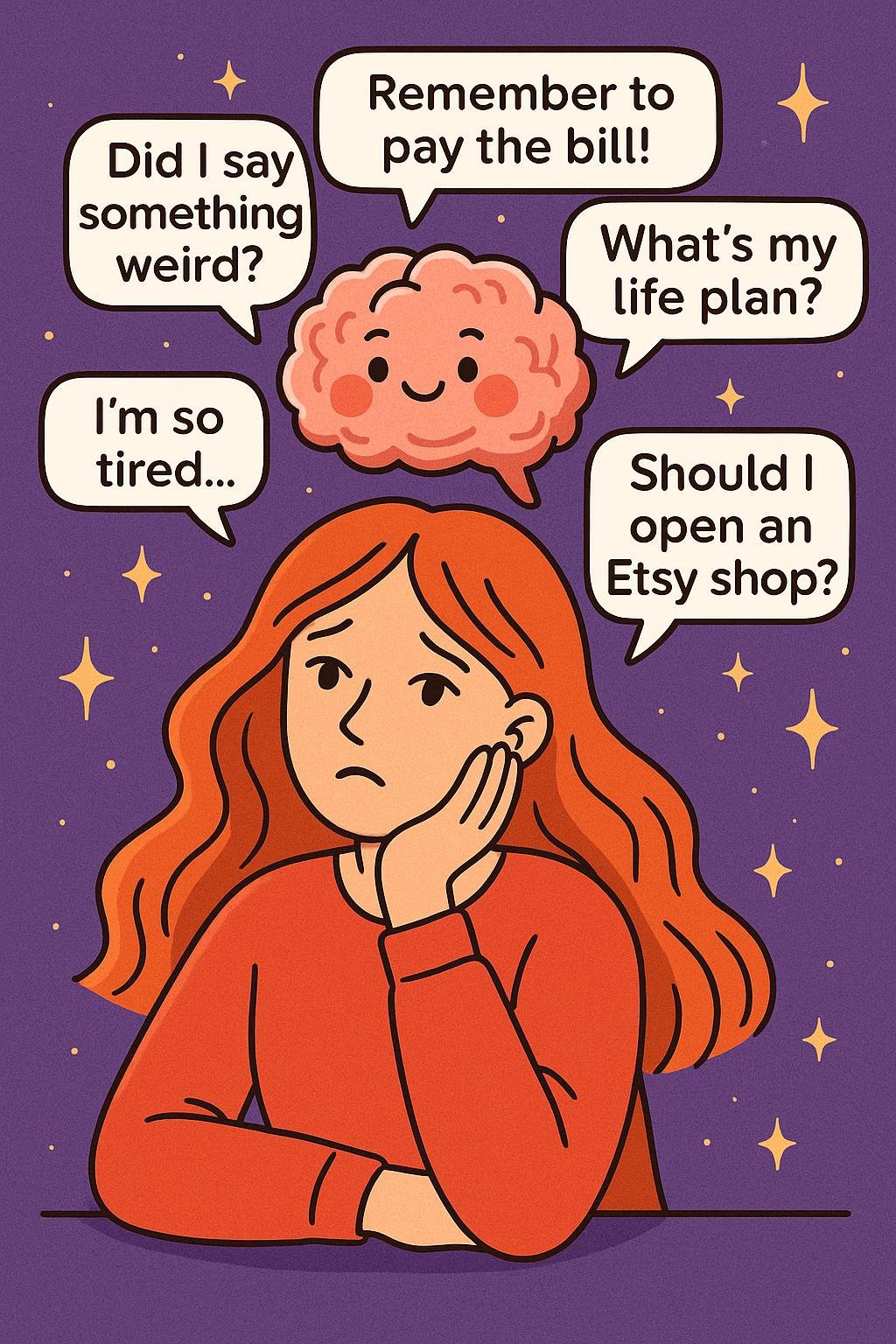
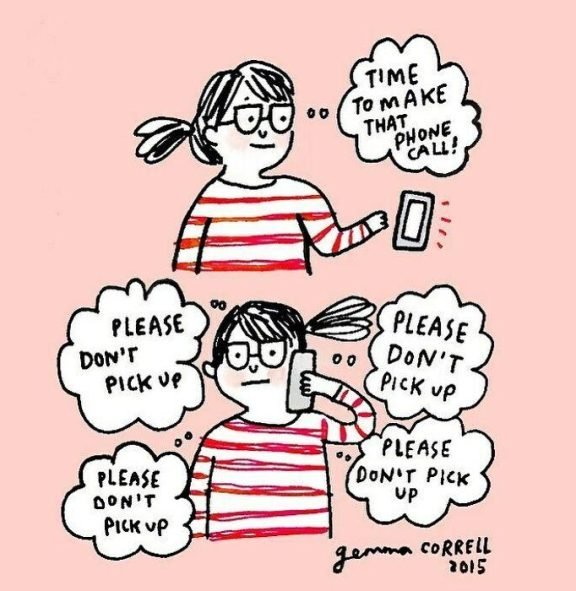
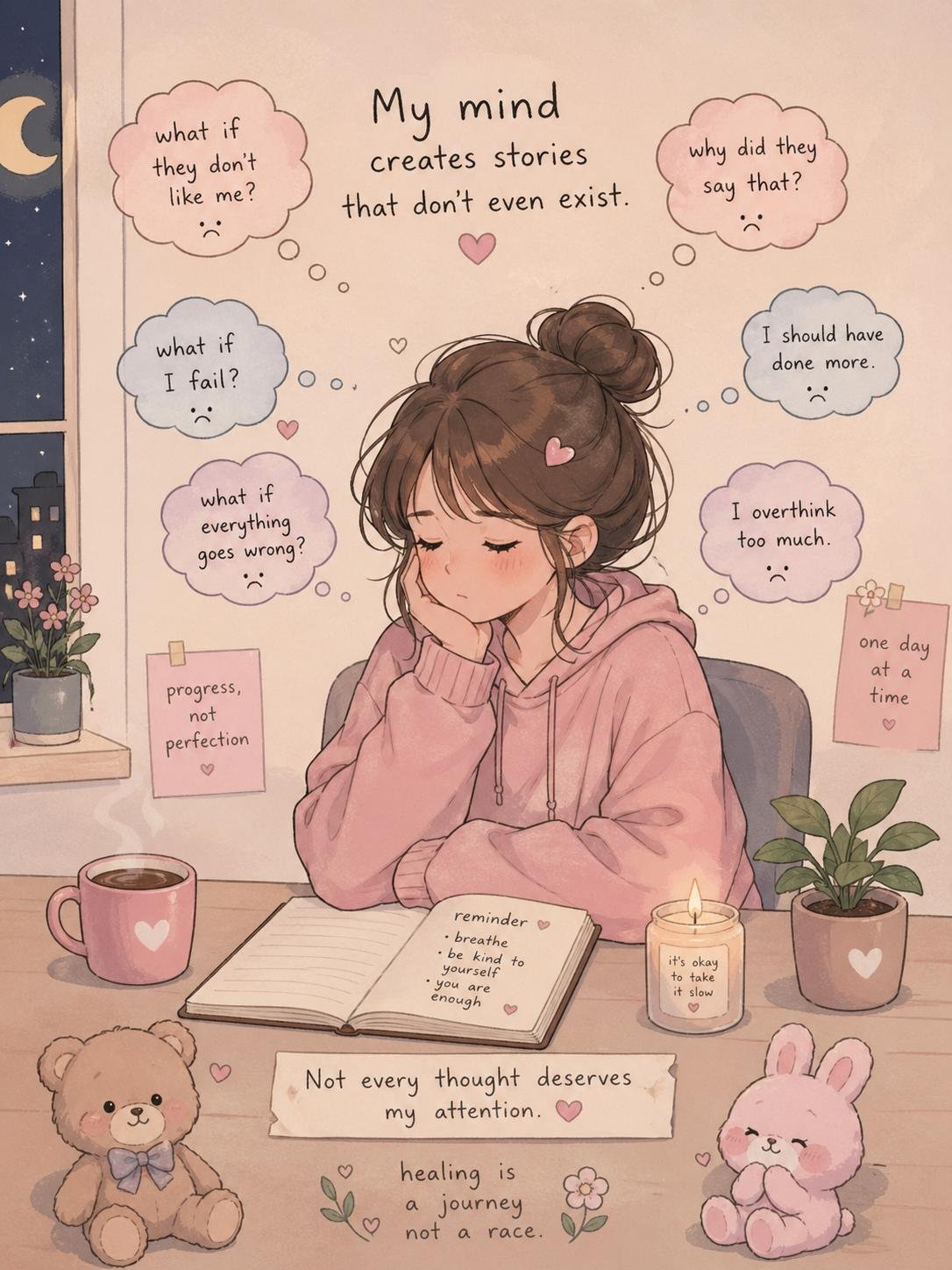
Are You Overthinking, or Is Your Brain Just Doing Its Thing?
Let’s be honest.
Sometimes you’re not even trying to overthink.
It just… happens.
You have a conversation.
You go home.
You make tea.
You scroll through your phone.
Everything is fine.
Then your brain quietly walks into the room carrying a clipboard.
“Hi. Quick question. Remember what you said earlier?”
No.
We do not remember.
“Interesting. Because I think we should discuss it.”
And suddenly you’re back.
Replaying the conversation.
Analyzing their facial expression.
Analyzing your facial expression.
Analyzing the meaning of the word “okay.”
Was it a normal okay?
An annoyed okay?
A please-never-speak-to-me-again okay?
At some point, you have analyzed one word so intensely that you deserve a degree in linguistics.
This is one of the frustrating things about overthinking: a small thought can turn into a much bigger story.
And sometimes, there isn’t even a problem to solve.
You’re simply trying to find certainty where there isn’t any.
That doesn’t mean there’s something wrong with you.
You’re human. Your brain thinks. Sometimes it just gets a little… enthusiastic.
When a Tiny Thought Turns Into a Full Story
Here’s how it usually goes.
The actual fact:
“They haven’t replied to my message.”
Completely neutral.
Then your brain adds:
“Maybe they’re busy.”
Still reasonable.
Then:
“Maybe they’re upset.”
Okay.
Then:
“Did I say something wrong?”
Hmm.
Then:
“Maybe I shouldn’t have sent that message.”
And five minutes later:
“Maybe our friendship is over.”
Congratulations.
You’ve gone from one unanswered message to the collapse of an entire relationship.
Your brain has written a whole story using approximately three pieces of information.
And the worst part?
It feels real while you’re thinking it.
This is why learning to separate what you know from what you’re assuming can be useful. NHS guidance on unhelpful thoughts similarly recommends stepping back, checking the evidence and considering alternative explanations rather than automatically accepting the first interpretation your mind produces.
Try asking yourself:
“What do I actually know?”
Not:
What could happen?
Not:
What if?
Not:
What does this probably mean?
Just:
What do I actually know?
Maybe the answer is:
“They haven’t replied.”
That’s it.
You don’t have to write the rest of the story.
You Don't Have to Figure Everything Out Right Now
This is probably one of the hardest things for an overthinking brain to accept.
We want answers.
We want certainty.
We want to know:
- What did they mean?
- What happens next?
- Did I make the right decision?
- What if something goes wrong?
- What if I regret it?
- What if they misunderstood me?
- What if…
And then another what if walks in.
And another.
And another.
At some point, you’re basically holding a board meeting with problems that haven’t even happened.
Here’s something you can try instead:
“I don’t know yet.”
That’s it.
You don’t need to immediately replace every uncertain thought with a positive thought.
You can simply admit:
“I don’t know.”
Maybe something will happen.
Maybe it won’t.
Maybe you made a mistake.
Maybe you didn’t.
Maybe that person is annoyed.
Maybe they’re eating dinner and haven’t looked at their phone.
You don’t always need an answer immediately.
NHS guidance similarly distinguishes between problems that can be acted on and hypothetical worries that are outside your control; for something actionable, you can make a plan, while for something you can’t currently change, shifting your attention can be more useful than repeatedly dwelling on it.
Okay, So How Do You Actually Reduce Overthinking?
Let’s make one thing clear.
We’re not trying to turn you into someone who never overthinks.
That’s unrealistic.
The aim is more like:
“Oh. I’m doing the thing again.”
And then:
“Okay. Let me step out of this for a minute.”
Here are a few gentle ways to do that.
What Do I Actually Know?
This might be the simplest question in the entire article.
When your brain starts building a story, separate the facts from the interpretation.
For example:
Fact:
They didn’t reply.
Interpretation:
They’re angry.
Fact:
My friend sounded quiet.
Interpretation:
They’re upset with me.
Fact:
I made a mistake.
Interpretation:
Everyone probably thinks I’m incompetent.
See the difference?
Your brain can be very convincing.
That doesn’t mean every thought is a fact.
So when you catch yourself spiraling, ask:
“What do I actually know?”
You might be surprised how much of the story disappears.
Maybe Get That Thought Out of Your Head
So, when you’re trying to figure out how to stop overthinking, start with writing it down.
Not a beautiful journal entry.
Not three pages about your childhood.
Just:
“I’m worried that they are upset with me.”
Then ask:
What evidence do I have?
Is there another explanation?
Is there anything I can actually do right now?
If there is something you can do, make a small plan.
If there isn’t, you don’t have to spend the next four hours mentally rehearsing the situation.
Writing worries down and setting aside a specific time to deal with them are among the practical techniques recommended by NHS Every Mind Matters.
Your notebook doesn’t need to be aesthetic either.
A random note in your phone counts.
Your brain does not care whether the font is pretty.
How to Reduce Overthinking Without Trying to Silence Your Brain
Sometimes you don’t need another thought.
You need a different activity.
Go outside.
Take a walk.
Make tea.
Cook something.
Take a shower.
Clean your room.
Call someone.
Listen to music.
Read.
Do something that brings you back into the actual world.
This isn’t about pretending the thought doesn’t exist.
It’s about not giving the thought your entire evening.
The NHS recommends shifting attention, focusing on the present and finding activities that help you relax or clear your mind; Cleveland Clinic also discusses healthy distraction such as walking, reading and meditation as strategies that may help interrupt repetitive worrying.
Sometimes your brain simply needs to realize:
“Oh. We have other things to do.”
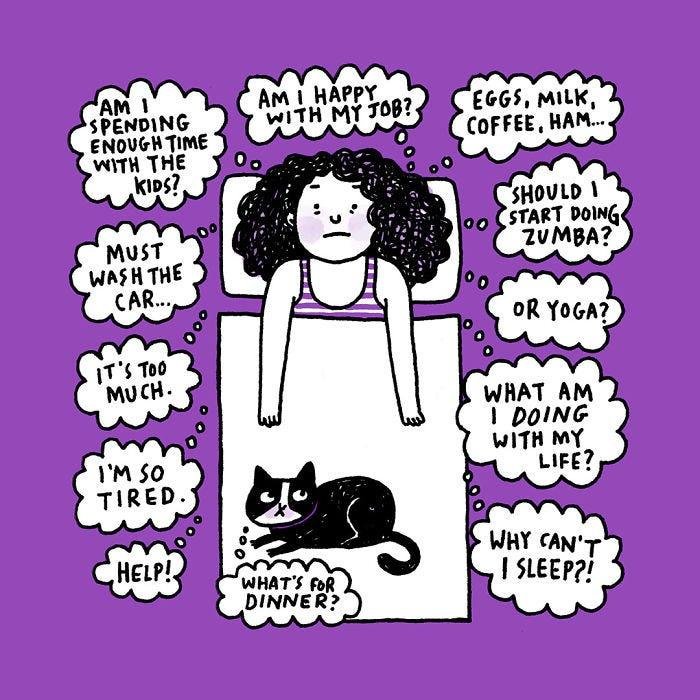
Why Does My Brain Schedule Its Most Important Meetings at 2 A.M.?
Of course it does.
Because apparently 2:13 a.m. is the perfect time to remember something embarrassing you said in 2019.
During the day:
“We’ll deal with that later.”
At night:
“Excellent. Everyone is asleep. Let’s discuss every decision you’ve ever made.”
😂
Nighttime can make thoughts feel especially loud because there are fewer distractions.
So if your brain suddenly decides bedtime is the perfect moment to solve your entire life, try not to argue with every thought.
Keep a notebook nearby.
Write down what is bothering you.
If there’s something practical you need to do tomorrow, write that down too.
For example:
Call Sarah tomorrow.
Done.
Your brain doesn’t need to keep sending you reminders every seven minutes.
And if there’s nothing you can actually do tonight?
Write:
“Nothing I can do about this right now.”
Then give yourself permission to leave it until tomorrow.
A structured “worry time” is one technique recommended by NHS Every Mind Matters for containing worries rather than letting them take over the whole day or interfere with trying to sleep.
Maybe You Don't Need to Stop Overthinking Completely
Here’s the part I really want you to remember.
You are probably going to overthink again.
Tomorrow.
Next week.
Maybe tonight.
You might be lying peacefully in bed when your brain suddenly says:
“Remember that slightly awkward thing you did three years ago?”
And you’ll be like:
“No. But apparently you do.”
😂
That’s okay.
The goal isn’t to become a person who never has unnecessary thoughts.
The goal is to notice:
“I’m stuck in this thought.”
And then give yourself a choice.
You can think about it.
You can write it down.
You can make a plan if there’s actually something to solve.
Or you can say:
“Not right now.”
And return to whatever is actually happening in your life
You Don't Have to Solve Everything Tonight
Maybe that conversation was awkward.
Maybe it wasn’t.
Maybe they are upset.
Maybe they’re just busy.
Maybe you made the wrong decision.
Maybe you didn’t.
Maybe something will happen tomorrow.
Maybe nothing will.
You don’t know yet.
And that’s okay.
You don’t have to solve every possible version of tomorrow before you go to sleep tonight.
You don’t have to replay every conversation until you find the “perfect” interpretation.
You don’t have to become perfectly calm.
You don’t have to stop being you.
Sometimes, you just need to notice that your brain has turned a tiny thought into an entire movie…
…and decide you’re done watching.
So take a breath.
Put the phone down.
Make your tea.
Go for that walk.
Watch something stupid that makes you laugh.
Or simply sit there and do absolutely nothing for five minutes.
You don’t have to figure everything out right now.
Tomorrow is allowed to be tomorrow.
And for tonight?
You can let your brain clock out. 🌿

Maybe learning how to stop overthinking isn’t about stopping every thought…
At the end of the day, your brain is going to do what it does.
It will overanalyze the text.
Replay the conversation.
Question the punctuation.
And, for reasons nobody understands, remember something embarrassing you did five years ago precisely when you’re trying to sleep.
Let it.
You don’t have to attend every meeting your brain schedules.
Some meetings can simply be cancelled.
No agenda. No minutes. No follow-up meeting.
Just you, getting on with your evening.
And maybe that’s how you start giving your mind a little more peace — not by making it completely quiet, but by learning that you don’t have to listen to every single thing it says.